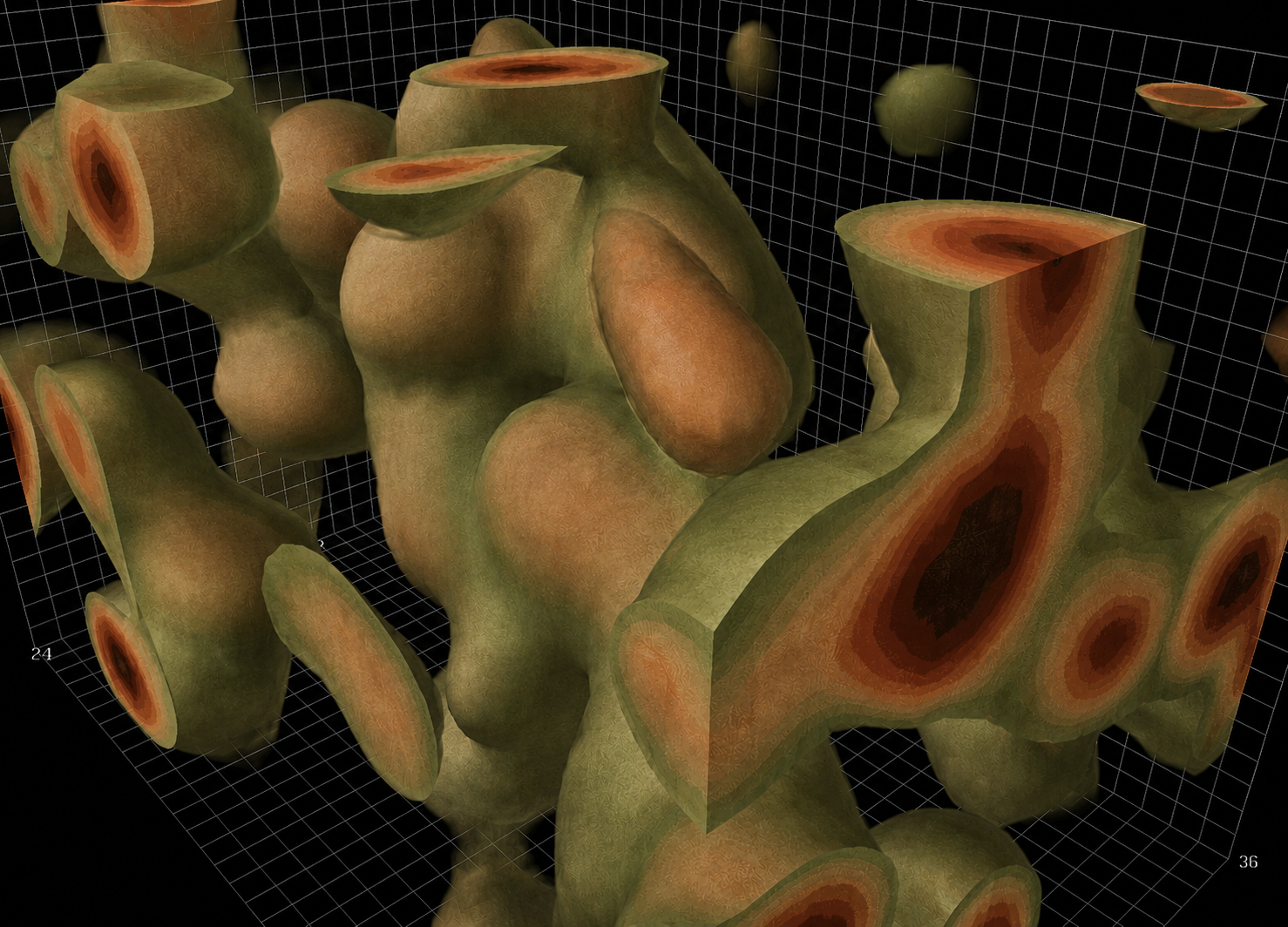
Is physical reality fundamentally composed of discrete entities separated by empty space—atoms, monads, or particles—or does there exist some continuous medium that binds things together? Western philosophy and science have repeatedly returned to this problem through a succession of concepts: the void, the plenum, the aether, the field, and, more recently, the manifold. Although these terms belong to different historical and scientific epochs, they can be understood as successive attempts to think the same fundamental problem: whether relation presupposes emptiness or continuity.
The earliest formulation of this problem appears in the opposition between the ancient atomists and Aristotle. For Leucippus and Democritus, reality consists of atoms moving through the void. Motion requires an emptiness that yields; without a void, movement would be impossible. The atomists therefore proposed a startling thesis: not only does being exist, but non-being—in the form of empty space—must also possess a kind of reality. Aristotle, most notably, rejected this conclusion entirely. Nature, he argued, in his Physics and On the Heavens, admits no vacuum. Every movement occurs through a medium. Air, water, and the celestial aether—the ‘first body’ that composes the heavens—do not merely surround moving bodies but make motion itself possible. The cosmos is therefore not a collection of isolated entities scattered across emptiness but a continuous plenum, a world fundamentally filled and ordered according to the natural tendencies of its constituent elements. Earth moves toward the centre of the cosmos, fire rises away from it, while the celestial bodies, composed of aether, move eternally in circular motion. Each element possesses its proper place, and the order of nature arises from these intrinsic tendencies (teloi) rather than from motion through an empty void. The tension between these positions would persist for more than two millennia. Indeed, much of the history of natural philosophy, particularly through Aristotle’s medieval reception, can be understood as a series of attempts to determine whether reality, nature itself, is fundamentally void or fundamentally full.
This question became particularly acute during the Scientific Revolution. René Descartes denied the existence of empty space altogether. Extension—length, breadth and width—and matter were identical in kind if not conceptually distinct; that is, wherever there is extension, there is matter, and wherever there is matter there is space. According to Descartes in his First Principles, the universe forms a vast plenum whose motions are transmitted through vortices of subtle matter. Yet Isaac Newton’s competing theory of universal gravitation reintroduces the possibility of action across empty space. Bodies, particularly stars, planets and comets, seemed capable of spontaneously attracting one another across great distances of empty space. However, Newton famously regarded such action-at-a-distance as deeply problematic. In a famous letter to Richard Bentley, he described the idea that one body might act upon another through a vacuum without mediation as an absurdity. Indeed, in his Optics, Newton himself discusses the possibility of an aethereal medium through which light and other forces including gravity propagate. However, the extraordinary predictive success of Newton’s gravitational theory left the problem unresolved.
At the beginning of the nineteenth century, physicists sought to resolve this difficulty through a renewed conception of the aether. Light, electricity, and magnetism increasingly appeared to propagate in ways analogous to waves. Huygens had proposed a wave theory of light in the seventeenth century, a position later developed by Euler in the eighteenth century and strongly supported by Thomas Young’s famous double-slit experiment in the nineteenth where light created a wave-like diffraction pattern. Once again, a profound analogy emerged between optics and other forms of physical propagation. Just as sound travels through air, light appeared to require an invisible medium permeating all space. The ‘luminiferous aether,’ that medium through which light travels, thus became an attempt to reconcile modern physics with the ancient intuition of the plenum. Although space might appear empty, and although experimental vacuums could be produced, many physicists held that the cosmos was in fact filled with a subtle substance through which light, electricity, magnetism, and perhaps even gravitation could be transmitted—those forces that appeared to act at a distance. While the aether was not simply a return to Aristotle’s or Descartes’ cosmos, it nonetheless preserved the conviction that action requires a medium and that apparently empty space is never truly empty.
A decisive transformation arrived with Michael Faraday and James Clerk Maxwell. Rather than conceiving forces primarily as interactions transmitted by a hidden substance, Faraday proposed that space itself possesses a determinate structure. His famous lines of force were not merely visual aids but expressions of real physical vectorial relations extending throughout space from their source. Maxwell subsequently translated these insights into a mathematical theory of electromagnetism. The result was the emergence of the ‘field’ as a fundamental concept. What increasingly mattered was no longer the existence of an underlying substance but the existence of determinate relations distributed throughout space. The field did not simply occupy space; it endowed space itself with physical significance.
At the beginning of the twentieth century, Albert Einstein would radicalise this shift. The Michelson–Morley experiment, an attempt to detect the velocity of Earth with respect to the hypothetical luminiferous ether had failed to detect a change in the Earth’s motion, and special relativity eliminated the need for such a medium altogether by suggesting that light travelled at a constant speed. Furthermore, general relativity transformed spacetime itself into a dynamic structure. Space was no longer an empty container in which events occurred; its geometry participated directly in physical processes. In a celebrated lecture of 1920, Einstein argued that one could even still speak of a kind of aether, provided one no longer imagined a material substance but rather the physical properties of spacetime itself. The old medium had not disappeared so much as been transformed. What had once been conceived as a substance filling space was now understood as the dynamical structure of space itself. Indeed, the concept of the manifold, developed by Bernhard Riemann and employed by Einstein, perhaps marks the most sophisticated expression of this transformation. The manifold of spacetime is neither a void nor a plenum in the classical sense. It is a relational geometric structure whose properties determine the possibility of relative motion, propagation, and interaction.
Joel White